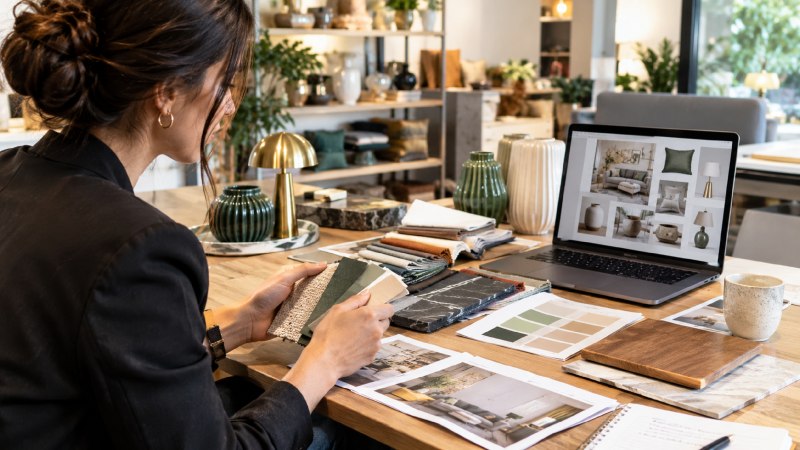
Most home accent trends feel like they appear overnight. They do not. By the time a boucle stool or a fluted glass vase shows up in a high street window, the people who ordered it made their decision somewhere between nine and eighteen months earlier, usually in a showroom, usually holding a sample.
Trends Show Up as Materials Before They Show Up as Objects
The first visible stage of any accent trend is rarely a finished product. It is a material behaving in a new way. Ribbed and fluted surfaces arrived in glass and acrylic long before they reached ceramic lamp bases and cabinet fronts. Warm metals came back through small hardware, drawer pulls and picture hooks, before anyone was selling a brass floor lamp.
That order matters for anyone tracking trends. Material shifts are cheaper for a manufacturer to test than whole new product shapes, so they move first. A stylist who watches what is happening to surfaces, weaves and finishes will see the direction of travel earlier than one who watches finished room shots.
Three material signals worth tracking at any given moment:
- Texture depth. Flat, smooth and glossy alternates with carved, ribbed, tufted and slubby on a slow cycle. Watch whether the new arrivals in a category are gaining or losing surface relief.
- Edge treatment. Rounded corners, soft radii and pill shapes read as one era. Sharp mitres and squared edges read as another. Edges change before silhouettes do.
- Metal temperature. Brushed nickel, chrome, antique brass, blackened steel and warm gold each carry a decade with them. A single change here re-dates an entire room.
Colour Moves Slower Than the Internet Suggests
Social feeds create the impression that colour turns over every few months. Retail reality is slower. A paint colour needs a full season of selling to prove itself, and an upholstery colour needs longer because the fabric has to be woven, cut and stocked before anything reaches a shelf.
What actually changes quickly is the accent proportion. The dominant wall and floor colours in most homes shift over years. What shifts over months is how much of a contrast colour appears in cushions, throws, ceramics and art. A room that looked current last year and dated this year has usually not changed its base at all. It has changed the ratio.
For a decorator, that is good news. Chasing a colour trend through big-ticket purchases is expensive and slow. Chasing it through the accent layer costs very little and can be reversed in an afternoon.
The Second Iteration Is the One Worth Buying
Early examples of any trend tend to be literal. When curved furniture returned, the first wave was aggressively curved, to the point where the shapes fought with every straight line in the room. The second and third waves softened it into something that could sit next to a normal doorway and a normal skirting board.
This is why experienced buyers often skip the opening run of a trend entirely. They watch it, note which manufacturers are doing it competently, and buy into the refined version once the proportions have settled. Readers decorating their own homes can use the same patience. A trend that survives into its second iteration is usually a trend worth living with.
Build quality is the other half of that judgement, and it is what separates a trend piece worth keeping from a landfill item. Accent pieces get handled constantly. Vases get moved for dusting, trays get loaded and carried, small lamps get switched on and off hundreds of times a year. The difference between an accent that lasts a decade and one that fails in a season is almost always in details that photograph badly.
Worth checking before buying anything decorative that is also functional:
- Weight distribution. A vase or candle holder that tips when empty will tip when full.
- Joins and seams. On ceramics, look at the base ring. On timber, look at where two pieces meet rather than at the face.
- Finish over edges. Paint and lacquer that stop short of an edge are the first place wear appears.
- Hardware fixings. Screws into raw particle board on a lightweight shelf will not hold a stack of books.
- Colour consistency. Two pieces from the same range should match under daylight, not just under showroom lighting.
Where the Products in the Accent Aisle Actually Come From
There is a step in the trend cycle that rarely gets discussed on decorating blogs, and it explains a lot about why certain looks appear everywhere at once. Independent shops, online sellers and interior studios building their own product ranges are all buying from a manufacturing base concentrated across Asia, and most of them meet those manufacturers at trade exhibitions rather than through cold enquiries.
Business-to-business marketplaces such as Global Sources sit at that junction, connecting retailers and studios to verified suppliers and to OEM and ODM factories that can produce a range under a buyer’s own label. That is the mechanism behind the familiar experience of seeing the same textured ceramic planter in four different shops under four different brand names. They are frequently the same tooling, finished differently.
Understanding this takes some of the mystique out of trend forecasting. A trend is not only a cultural mood. It is also a set of production decisions that thousands of buyers made in the same window.
What Changes When a Buyer Sees a Season in Person
Photographs flatten everything. A glaze that looks deep and mottled in a catalogue can look muddy in daylight, and a woven basket that looks handsome online can arrive smelling of damp. This is why buyers still travel, and why the home and lifestyle halls of the large sourcing exhibitions carry so much weight in the decor calendar.
The Global Sources Hong Kong Shows run at AsiaWorld-Expo in two phases, 11 to 14 October and 18 to 21 October 2026. Home, decor and lifestyle products sit in the second phase alongside smart home and appliance categories, and a buyer working the lifestyle show halls can compare dozens of interpretations of the same idea within an hour. Across both phases the event brings together more than 4,200 suppliers and over 8,000 booths, with more than 330,000 new products on display.
Walking a hall like that is where trend rumours become facts. If eight unrelated factories have independently developed a scalloped edge in the same season, that is a trend. If one has, it is a product.
A Quick Way to Judge Whether a Trend Has Legs
| Signal | Short-lived trend | Trend with staying power |
| Where it appears | One material only | Across ceramic, textile and timber |
| Shape logic | Novelty silhouette | Refines an existing classic form |
| Price spread | Only at one price point | Interpreted at budget and premium |
| Room fit | Needs a whole room built around it | Works beside existing furniture |
| Care requirement | High maintenance finish | Wipes clean, ages acceptably |
Anything scoring on the right-hand column is worth buying properly. Anything on the left is worth buying cheaply, in small quantities, and without emotional attachment.
Using Trend Knowledge Without Redecorating Constantly
The practical version of all this is a layered approach. Keep the expensive, slow-moving layer neutral and well made: sofas, rugs, storage, lighting bodies. Put the trend appetite into the fast layer: cushion covers, throws, ceramics, small art, table linen, lampshades. Refresh that layer once or twice a year and a room stays current without a single large purchase.
The other habit worth borrowing from professional buyers is note taking. Photograph the pieces that keep catching the eye across a season, then look at the set as a whole. The through-line in those photos is usually a clearer brief than any published trend report, because it reflects an actual taste rather than a forecast.
The Short Version
Trends arrive through materials, get refined on their second pass, and reach shelves because a large number of buyers made the same call at the same sourcing event roughly a year before. Watching surfaces, edges and metals gives an early read. Buying the second iteration rather than the first gives a better object. Keeping the trend layer cheap and changeable gives a room that stays current without a rolling renovation budget.