The Engineering Puzzle Behind Modern Timber Roofs
Long-span timber roofs sit at a fascinating intersection of craft, engineering, and architectural ambition. Wide-open interiors, vaulted ceilings, and dramatic great rooms all depend on overhead structures that can carry significant loads while remaining visually graceful. The challenge facing today’s designers and fabricators is not simply how to span longer distances, but how to do so without burying the structure under its own weight. Heavier members demand thicker walls, deeper footings, and larger cranes, all of which compound cost and complexity. Solving for span and lightness simultaneously has become one of the defining problems in contemporary timber construction.
Why Solid Timber Hits a Practical Ceiling
A solid wood beam strong enough to span thirty or forty feet without intermediate support quickly becomes an engineering liability. Mass scales with cross-sectional area, so doubling the depth of a beam often more than doubles its weight. That added weight pushes back through every connection, every wall plate, and every foundation pad below. Crews lose hours wrestling oversized members into place, while structural engineers spend extra cycles reinforcing the framing that supports them. Beyond the logistics, very large solid timbers are also expensive and increasingly difficult to source in consistent quality. The natural cracking, checking, and twisting that occur as massive sections dry add further complications.
The Hidden Cost of Overbuilt Members
When a beam is oversized for its role, the consequences ripple outward. Roof framing schedules stretch, crane rentals extend, and the additional dead load forces the entire load path to be uprated. Architects who specify exposed timber for its warmth and texture often discover that the very member meant to anchor the room is dictating compromises in every adjoining detail. The fix is not to abandon timber, but to rethink how the cross-section of a beam is composed.
What Timber Beam Design Balances Long Spans and Reduced Weight?
Large-span timber roofs place pressure on both structural performance and installation logistics. Heavy solid beams increase crane requirements, complicate framing schedules, and add load to supporting walls and foundations. Architects also need beam systems that preserve clean ceiling lines while maintaining the natural appearance of exposed wood across wide interior spaces. Engineered timber fabrication solves that challenge by reducing unnecessary mass without sacrificing rigidity or span capability.
Many builders address those requirements with custom box beams. Custom fabrication allows the beam depth, width, connection details, and finish to match exact structural and architectural requirements instead of forcing a project to adapt around standard stock sizes. The hollow-core beam profile reduces overall weight while maintaining strength across long roof spans, which improves handling during installation and lowers structural demand on adjacent framing systems. Timber fabricators also integrate concealed fastening systems and steel reinforcement when a project requires higher load capacity or cleaner exposed finishes.
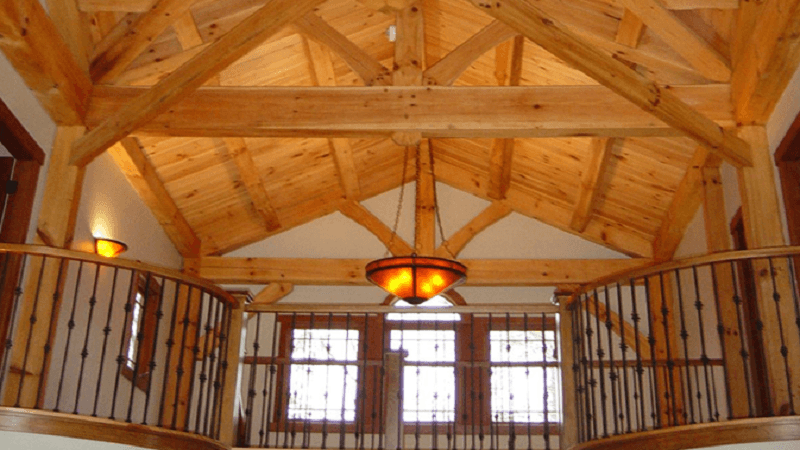
That combination of engineered performance and architectural flexibility makes box-style timber beams common in large residential great rooms, commercial timber-frame structures, vaulted ceilings, and open-plan interiors. Designers gain wider uninterrupted spaces, contractors simplify lifting and placement, and property owners retain the warmth and visual texture associated with exposed structural wood. Custom manufacturing also improves alignment with project-specific engineering calculations, reducing field modifications that delay framing and finishing schedules.
The Physics of a Hollow Section
The intuition behind a hollow timber beam is borrowed from the same principles that shape steel tubes and aircraft spars. Bending stress in a beam is concentrated near the outer fibers, not in the center. Material placed close to the neutral axis contributes far less to stiffness than material at the top and bottom flanges. By removing the underused core and reinforcing the outer walls, a beam can retain most of its load-carrying ability while shedding a remarkable amount of weight. The result is a section that performs like a much heavier piece of solid timber but moves and installs like something far smaller.
Adhesives, Reinforcement, and Concealed Hardware
Modern structural adhesives and engineered joinery have changed what is possible inside the wall cavity of a box beam. Internal blocking, steel flitch plates, and ribbed cores can be tailored to specific deflection limits and point loads. Concealed knife-plate connectors disappear into routed slots, allowing the finished beam to land cleanly against ridge boards and posts without visible hardware. Designers can specify finishes ranging from rough-sawn reclaimed faces to glass-smooth millwork-grade surfaces, all wrapped around the same lightweight engineered core.
Architectural Payoff Inside the Home
Exposed timber overhead changes how a room feels. Ceilings gain rhythm and depth, and the wood grain ties the structure to other natural materials throughout the interior. Many homeowners build on that warmth with thoughtful furnishings below, pairing the overhead grain with broad wood casework and storage pieces. A well-chosen wood entertainment center for the living room picks up the same tonal language as exposed roof beams and helps a great room feel intentional rather than merely large. Designers often coordinate stain palettes between structural timber and freestanding furniture so the eye reads the space as one continuous composition.
A Wider Renaissance in Timber Craft
The popularity of engineered timber roofs is part of a broader return to wood as a serious structural material. Mass timber towers, cross-laminated panels, and revived heavy-timber workshops have all helped reposition wood as a high-performance choice rather than a nostalgic one. Industrial design coverage of the movement, including this profile of timber craftsmanship at Industry City, illustrates how fabricators are pairing traditional joinery with modern CNC milling to produce architectural elements that would have been impractical only a decade ago. The same advances driving boutique furniture studios are reshaping how structural beams reach the job site.
Tarriver and the Craft of Engineered Timber
Tarriver has built its reputation on translating these engineering and architectural principles into practical, made-to-order beam systems. Each project begins with the specifics of the span, the load path, and the look the designer has in mind, rather than a catalog of fixed sizes. The fabrication team works with architects, builders, and interior designers to dial in depth, width, profile, species, and finish, then engineers the internal structure to match the calculated demand. Concealed fasteners, reinforced cores, and hand-finished surfaces are coordinated in the shop so the field crew receives a member that lands cleanly and reads as a single sculptural element on site. The result is a product that respects both the discipline of structural engineering and the character that draws people to exposed wood in the first place.
Conclusion
Long-span timber roofs stay lightweight without losing strength because their designers have learned to put wood where it matters most and remove it where it does not. Hollow-core beam profiles, engineered reinforcement, and custom-tailored geometry have replaced the brute-force logic of ever-larger solid timbers. The payoff appears in faster installations, lighter loads on supporting structure, and ceilings that feel both expansive and grounded. For architects, builders, and homeowners who want the warmth of exposed wood without the penalties of unnecessary mass, engineered box-beam construction has quietly become the standard worth specifying.