
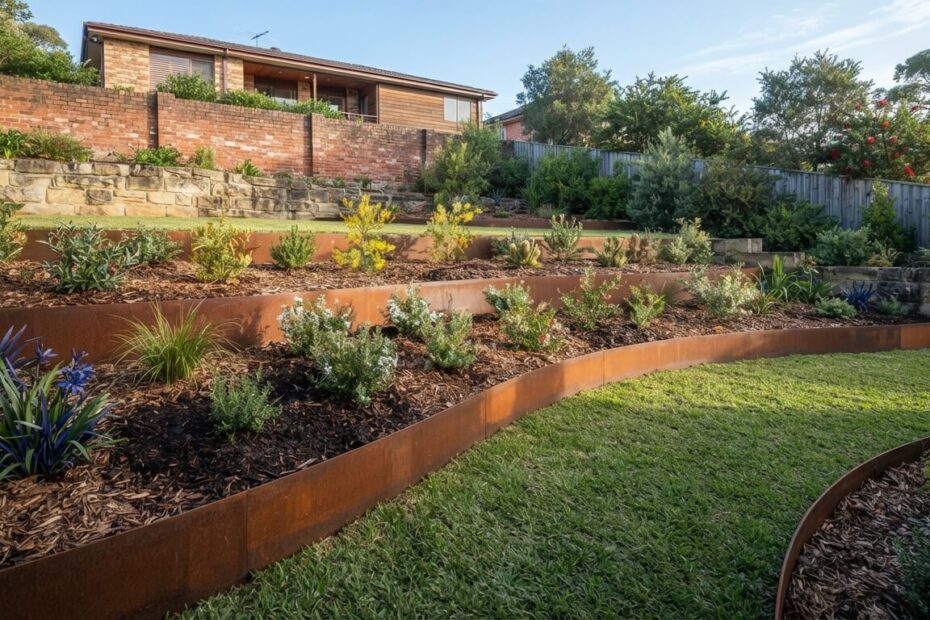
Most of the advice on garden edging Sydney gardeners come across assumes flat, free-draining ground. A lot of Sydney doesn’t have that. Out west, through the Hills district and across much of the south-west, the soil is heavy clay. Plenty of those blocks also fall a metre or more from the back fence to the house. Both change how a border needs to go in.
What Clay Does to a Border
Clay swells when it’s wet and shrinks as it dries, and Sydney gives it plenty of both. A summer of humid afternoons and heavy storms soaks it through, then a dry stretch in late winter pulls it back again, and that’s enough to work a shallow edge loose. It might lift a little at one end first. A couple of seasons later, the clean line from installation day has a wave in it.
Depth is what fixes it. On heavy clay, setting edging 75 to 100mm below the surface gives it enough grip to hold against that movement, where 50mm is usually plenty in looser loam. It’s harder digging, no question. Soaking the line the day before helps more than people expect, because dry Sydney clay can be close to impossible to get a spade into.
Water is the other half of the problem. Clay holds onto it, and a bed edged in at the same level as the lawn can sit waterlogged for days after a storm. Building the bed up a little with compost and organic matter helps here. Once it sits slightly proud of the turf, it sheds water instead of collecting it.
Sloping Blocks Need a Different Approach
On a slope, soil pushes downhill constantly, and the pressure builds at the low end of every run. Edging that sits happily on flat ground starts to bow outward there within a season or two.
A few adjustments make the difference:
- Stakes roughly every 500mm along any run that follows the fall, rather than every metre
- Extra depth on the uphill face, where the load is heaviest
- At least a third of the profile buried. A 200mm profile wants 65 to 70mm in the ground
- Beds running across the slope where possible, so stormwater slows down instead of scouring a channel along the edge
Steeper blocks often reward a bit more ambition. Taller profiles can hold small changes in level, turning one awkward fall into two or three flat beds that are far easier to water, mulch and plant. A terraced front garden on a sloping Sydney block looks much harder than it is once the levels are set out with string lines.
What Holds Up on Wet Clay
Timber struggles on wet clay. Because clay drains slowly, the boards sit in damp soil for days after every storm, and the rot usually starts at the base where nobody sees it until the board gives way. Materials that don’t take on water tend to last much longer here. Stone and concrete cope with the damp well, and steel does too, with the added advantage that it can bend into curves and follow the natural contour of a sloping block.
Steel edging comes in a range of heights, from low bed borders of around 75mm up to taller profiles built for terracing. Where a border is retaining soil, a thicker gauge is worth it, and 2.5mm steel copes with that pressure far better than the thinner profiles. Weathering steel develops a warm rust tone that sits well against the sandstone and brick found in so many Sydney gardens, while galvanised steel keeps a cooler silver-grey.
Clay Gets Better With Time
Clay has a reputation as the enemy, but once it’s opened up it holds nutrients and moisture far better than sandy soil does. It just needs time to get there, and a border that stays put gives it that time. Each year of compost and mulch held in place leaves the bed a little darker and easier to work, and by the third or fourth spring the spade goes in without much of a fight.